

10.2 Slot machines ...and video poker

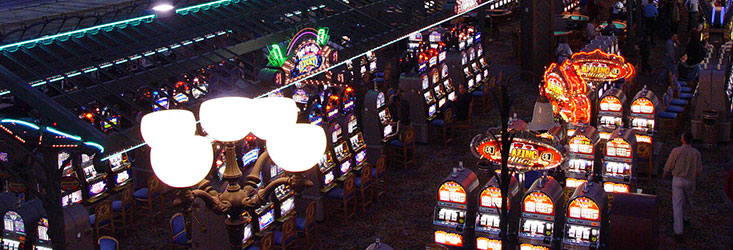
It is not accidental that two-thirds of every casino is littered with row-upon-row of slot machines of every type imaginable. The reason is that they provide the most profit to a casino ...and billions of dollars in tax revenue to the state. (The state of Nevada collects a $250 annual tax plus a $20 quarterly license fee per slot machine plus a percentage - about 5% - of gaming revenue.)
Slots account for more revenue to a casino than all other gambling games combined. Their formula for success is simple. They make money by paying out less than they take in. They are popular because players don't need any gambling knowledge and slots require only a very small bet. There are more than 200,000 slot machines in Las Vegas.
Most slot machines work the same way. The player pulls a handle or presses a button to spin a series of reels (typically three) that have pictures printed on them. You win when certain combinations of pictures line up with a pay line in the middle of a viewing window. The payout depends on which pictures land along the pay line. Some machines have multiple pay lines. A pay table (chart) tells you the amount of the payout. It is usually found on the front of the machine, above or below the area containing the wheels. While you can lose your money faster, the payout percentages are always better if you bet the maximum amount of coins on each “pull.”
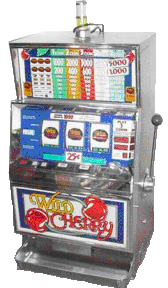
All slot machines in use today in casinos are electronic (computerized) rather than mechanical. As a general rule, reels, handles, sound effects and other attributes are there to make them appear to be like older, more familiar, mechanical machines.Themed slot machines that require the manufacturer to pay a license fee (such as one named after a movie star, cartoon character, TV show, etc.) generally have lower payouts since the additional cost must be recouped. So stick with the traditional machines (such as the Double Diamond, Blazing 7s, and Red, White and Blue) that pay back more.
As a general rule, slot managers place their most popular - and best paying - machines in areas that generate excitement - such as near the front entrance and other high traffic areas. Some popular slots - such as nickel machines - are placed in the rear of the casino to get people to walk to the back. High payback machines are also sprinkled throught the casino floor.
Be aware that the higher the cost per "handle pull," the higher the payout. According to one industry insider, the so-called "hold percentage" on the Las Vegas Strip averages 11% for nickels (that is, 89% is paid back), 6.5% for quarters, 4.5% for dollars, and 3.5% for five dollars and above. (The Nevada Gaming Control Board has a slighty different figure. See below.)
The payback percentage for Las Vegas (and all Nevada) slot machines are a known factor. Because they are taxed, all machines are strictly controlled and keep track of "coin in" and "coin out" which, overall, is a matter of public record. Manufacturers program each machine to payback a specific percentage which is based on a span of ten million handle pulls! Any slot can (and does) pay out more or less over a shorter period. It might pay out 400% today ...or 20% for a week.
A good website on slot machine gambling is located here ... and they have no advertising whatsoever.
The newest wrinkle in slot machines is coinless slots. They use bar-coded paper tickets instead of coins and are known as “ticket in/ticket out” ("TITO") machines. The traveling coin gal (and coin cups) are fast becoming a thing of the past. You feed bills and get paid in vouchers which are redeemed at the cashier’s cage. Don't forget to redeem the tickets! Some have expiration dates on them.
Video pokerAlthough poker machines have been around since 1964, video poker did not become popular until 1979 when International Game Technology (IGT) introduced its electronic “Draw Poker” machine. Video poker adds the element of skill and players are given decision-making options that regular slots don’t offer.
Video poker slots work the same way as regular rotating wheel machines. Instead of a reel, they have changing playing card images. They are generally based on five-card draw poker.
A series of five cards are generated from a freshly shuffled 52 card deck for each play and shown on the screen. The player discards some (or all of the cards) and replacements for the remaining cards are drawn. While you are deciding which cards you want to hold, the remaining 47 cards are constantly shuffling. After you decide and hit the button again, the cards stop shuffling and the x-number of cards you need to fill your draw hand come off the top and occupy the vacated positions.The objective is to get the best poker hand. Again a chart indicates the amount of the payout.
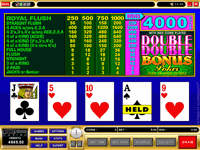
The most basic version pays on two jacks or better, but there are variations, such as “wild” cards.
All video poker is not alike. Be certain you are playing a “full pay” game which pays out 99.5% of incoming coin. They are known as a “9/6 JoB” machines – which stand for a payout of 9 coins for a full house and 6 coins for a flush with one coin inserted. (JoB stands for “Jacks or Better.”) The paytable for a full-pay or 9/6 JoB machine looks like this:
| Royal Flush 250 | Straight Flush 50 | Four of a Kind 25 |
| Full House 9 | Flush 6 | Straight 4 |
| Three of a Kind 3 | Two Pair 2 | Jacks or Better 1 |
A casino can tighten a Jacks-or-better video poker machine by simply paying out less for a full house and flush. The most common way that a casino increases it's win is to pay only 8 for the Full House and 5 for the Flush. This is a short-pay 8/5 machine. The casino keeps an extra 2.2% on these machines.
A “10/7 DB” video poker machine (Full House=10 coins, Flush=7 coins) is better yet Payout (when played perfectly and max-credits) is 100.1%. Double Bonus Poker (DB) is a variation on video poker in which the payout for two pair is reduced from two to one in exchange for greatly increased payouts for other hands ...like a payout of 4000 for a Royal Flush.
The best place to play video poker is downtown or at such off-strip properties as Sam’s Town. A great video poker website is VideoPokerReview.com.
A couple of playing hints: Never keep a high card kicker with a pair; draw three cards. Hint No. 2: Always go for the Royal Flush if you have four of the five needed ...even if it means giving up a high pair. The odds are one in 52 that you will hit the needed card ...and Royal Flushes pay up to 4,000 to one if you put in the maximum number of coins.
Slot machines and the lawAll slot and video poker machine models are tested by the state of Nevada to be certain that all results are based on a random number generator (RNG.) A new machine can’t be introduced until it meets all state regulations and technical standards. Because gross revenue is taxed, every machine keeps track of the money paid in and the winnings paid out.
Winning at slot machines is pure luck. And there is no such thing as a machine being “ready to hit.” The chances of winning never change whether it is the first or one hundredth pull. And a machine that hasn't paid recently is not due to win.
While winning combinations are determined on a totally random basis, the overall payback percentage is set on a standard machine. A casino tells the slot machine manufacturer what percentages it wants specific machines to pay back and that amount is programmed in. So, some machines are “looser” than others over the long haul.
The payback percentage is determined by state-approved computer chips which are installed by the manufacturer. The RNG in these microchips continuously generate hundreds of randomly chosen numbers every second the machine is on ...even when not being played. Each number corresponds to a set of symbols on the wheel. There are many approved chips for every machine type and the chip can be changed by casino technicians to “tighten” or “loosen” the machine payout. But this is hardly ever the case. It is easier just to change out the machine programmed by the manufacturer.
The state of Nevada requires that every machine pay out a minimum of 75 percent of the money it takes in. Due to competitive pressures, however, the overall payout percentage is much higher. Slot machines are typically programmed to pay out around 82 to 98 percent of the money that goes into them as winnings. Most pay around 92 to 96 percent ...certainly not the worst bet in the house. (Don’t be taken in by casinos that advertise winnings of “up to 99 percent.” They might only have one machine out of 2,000 set to pay that rate.) Hint: Playing the maximum coins always pays more per “coin-in” and reduces the house advantage.
Where are the “loose” slots?According to the Nevada Gaming Control Board, $1 slots pay out an average of 95 percent of receipts. (25 cent slots pay back an average of 93 percent, 5 cent machines: 90 percent.) And where you play the slots makes a difference. The payout on machines located on the Strip is about one or two percent lower than downtown or other off-strip properties ...a fact well known by the locals. Hotel-casinos frequented by Nevada residents on a regular basis (such as Sam’s Town) pay better than tourist hotels whose guests are there for only three days.
The newer and more luxurious hotels, have the poorest overall slot payout ...especially on under $1 machines. The poorest then would be the Bellagio, Venetian, Mandalay Bay and new Wynn Las Vegas. The best paying slots on the Strip are the older properties on the North Strip. Generally, avoid slots at the airport, convenience stores, restaurants and “restricted” operations ...that is, those with less than 15 machines.
Many veteran slot players believe that the loosest (best paying) machines are located in high traffic areas, such as near elevators, buffets, aisles, showrooms, registration areas, etc. Theoretically, frequent payouts are good advertising and entice others nearby to play. Typically, slot machines with a similar payout percentage are grouped together in the same area. In any event, the payback percentages on Nevada slot machines are the highest of any state ...and probably the highest of any country in the world.
Progressive slot machinesProgressive slots are exactly what their name implies; with each bet made, the jackpot grows. Progressive jackpots (such as Nevada's “Megabucks”) can pay astronomical amounts ...always in the millions of dollars. Their payout system is different from a standard machine and steadily increases as players put more money into it. To get the high jackpot, multiple machines and casinos are linked together to form one giant payout. Just about every Las Vegas casino participates in Megabucks.
The cardinal rule is to always play maximum coins at a progressive machine since they only pay the top jackpot if you bet max. Megabucks is a $1 slot so you must play 3 coins ($3.00) to hit the jackpot. When someone wins, the jackpot is reset to a starting value ...$7 million for Megabucks.
In the long run, the chances of winning a progressive jackpot are very, very remote and the overall payback is much lower than the standard $1 machine. Statistically, they are a very poor bet. In the short run, however, anything can happen and the “Megabucks” jackpot does get hit by someone about twice a year. (The odds of winning are one in 50 million.) The payout averages more than $10 million each time it does. It might be worth one $3 play.
Slot clubs and “comps”Most casinos offer free memberships in “slot clubs.” They exist to attract, reward, and ultimately retain slot players. You join at the casinos slot booth and get a membership card - otherwise known as a “comp card” (as in “complimentary.”) It looks like a plastic credit card. The purpose of these clubs is to keep players from wandering from one casino to another. The card tracks your play and are the Vegas equivalent of frequent flier miles.
Whenever you sit down at a slot machine, insert the card in the slot at the top of the machine. At a table game, you give it to the dealer or the floorman. The machine (slots) or casino personnel (table games) then keeps track of how much you bet and how long you have played. A word to the wise! Never place your handbag on the floor when you are playing the slots. Keep it in sight at all times.
There are two schools of thought about applying for slot card membership. One is to apply for as many as you can because you will get a sign-up bonus prize on the spot for enrolling ...sometimes even a little free "match play" gambling money to get you started. Joining a player’s club also identifies you as a gambler and gets you on their mailing list of upcoming offers. There are dozens of different slot clubs in Las Vegas.
The second theory is to concentrate your gambling - even if it is conservative - on one casino. You won’t get any “comps” (free meals, rooms, upgrades, shows or other offers) with just a few points at a dozen casinos. But they will add up when you gamble using a single slot card.
My recommendation is, at the minimum, to apply for Players Club membership at the two largest Las Vegas casino operations: MGM Mirage and Harrahs Entertainment. This way you can gamble at many of their owned casinos and still receive credit toward on your card. MGM Mirage recently merged with the Mandalay Bay Group. And Harrahs recently acquired Caesars Entertainment, Inc. These two companies will soon control nearly two dozen of the largest hotel-casinos ...about half the hotel rooms on the Strip.
Slot tournamentsSlot tournaments can be fun, take no skill to play and are offered at many casinos to their slot club members ...some by invitation only. The idea is to get the most “credits” by continually pushing the slot’s spin button. Sometimes the contest is free to enter ...but usually there is a small ($10 to $25) entry fee. The people who get the top scores wins a prize ...sometimes hundreds or thousands of dollars. Participants frequently get freebies and offers (sometimes worth more than the entry fee) just for entering the tournament.
The rules are simple. Generally you are assigned a certain machine, a time to play and a beginning amount of “credits” which must be played during a specified time period. For example: you might get to play a beginning 1000 credits in 15 or 20 minutes. The tournament is managed by casino personnel and there can be several tournament sessions to accommodate all who want to play. Many tournaments have hundreds of participants.
You just keep tapping the maximum bet button as fast as you can. Three credits are deducted each time. The machine has a special meter that keeps track of winning credits which can not be replayed. At the end of the time period, the machine locks up and play is over. An important objective is to use all your credits since they are lost if you do not. After you finish playing, you wait at your machine until a tournament official comes by and records your score. The scores on the winning meters determines the winners. It is that simple.
Slot tournaments are held in certain designated casino areas on specially programmed and outfitted machines that generate many more jackpot combinations than normally the case.
One advantage of a slot tournament is that you know ahead of time that your maximum loss will be the amount of the entry fee. (You should probably avoid the slot tournaments that have large entry fees ...those more than $100!) Winning them is totally pure luck ...the only skill needed is to be able to push the spin button quickly.
NEXT PAGE: 10.3 CASINO GAMES YOU SHOULD NOT PLAY! ⇨