
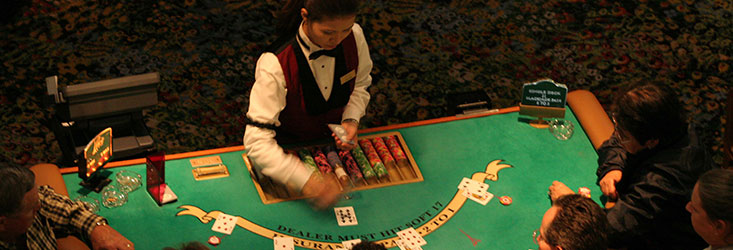

10.4 Blackjack ...a good game to play
Otherwise known as 21, Blackjack is by far the most popular table game in Las Vegas. It got its name due to the now obsolete practice of paying a bonus to hands consisting of an Ace and a Jack of Spades (a Black Jack).
Blackjack is easy to play and the chances of winning are good if you play right. The house advantage can be reduced to under 1% if the player religiously follows a set of rules known as “Basic Strategy.”
I mentioned earlier that I have been more successful in recent years in handling my gambling budget (about $500 a trip.) Over the last few years, my results have improved ...that is, I have not lost much and may even be a little ahead. I am satisfied if I break even in Las Vegas. I concentrate on Blackjack.
I am going to assume that you know nothing about the game, so here is what you need to know.
1. The idea of the game is to have a hand value that is closer to 21 than that of the dealer, without going over 21. There can be one to seven players. The number playing makes no difference to you as a player, you play only against the dealer.
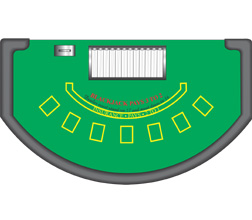
2. The house rules are generally printed on the table top felt between the dealer and the players. Most likely it will say: “Blackjack pays 3 to 2,” “Dealer must stand on 17 and draw to 16,” and “Insurance pays 2 to 1.” Be very suspicious of any Blackjack table that does not have printed rules. Do NOT play on any Blackjack table that does not pay 3 to 2 on Blackjack. (Blackjack, of course, is an ace plus a ten or face card.) While players have a choice whether or not to draw additional cards, the dealer does not. The dealer must draw a card whenever their total is 16 or less. An Ace in the dealer's hand is always counted as 11 if it can be accomplished without the dealer going over 21. The player can make decisions, the dealer can not. A dealer plays only one hand. (They can not split pairs.)
3. Most Blackjack games use six decks (although it can be eight) all shuffled together and dealt face up to players from a rack called a “shoe.” Every so often the cards are reshuffled ...usually by a machine. It is better for a newcomer to play “shoe” dealt Blackjack since all player cards are dealt face up and you will be able to see what others do in specific situations. Casinos like Blackjack dealt from “shoes” and shuffling machines because it increases the number of hands played per hour.
4. The first action by the player is to lay down a bet on the table. (...in a round spot designated for each player.) A small sign on the table states the betting minimum. You will need some chips, so put cash on the table and ask for chips. The dealer is not allowed to take money from your hand ...only from the table top. You will be furnished with chips matching the entire amount. Note that each chip’s denomination has a different color. An appropriate “buy in” is ten times your average bet. So on a $5 minimum table, start with $50 or more. (I generally start with $100, but I quit playing - at least for a while - if I lose $50.)
5. Most Strip casinos have a $10 minimum ...some even $25. Try to find a casino with a $5 (or less) minimum. They are usually on the North Strip, downtown or Off Strip. Unless you are a hardened gambler, there is no sense in betting more than you have to. The goal is to have fun and, with Blackjack, the house has a slight advantage ...and more with new players. You’ll find the lower limit tables are generally the most crowded with players. There is a reason for that; the house winnings from a $25 minimum table, for example, are five times that of a $5 table.
6. The dealer gives each player two cards, face up (one at a time going clockwise.) The dealer gets one face up and one face down. If the dealer’s face up card is an Ace, the dealer will offer “Insurance” - more on that later. The dealer will then check to determine if he/she has a Blackjack ...usually accomplished with a novel card reading device. If the dealer has a 10-value card (10, Jack, Queen ,King) under the Ace, all player’s lose unless the player also has a Blackjack. In which case, a tie (or “push”) is declared. The result is a standoff and the house (dealer) does not collect your bet on a “push.” Players are not allowed to touch the cards.
7. Blackjack “signals.” Ideally, the game is played silently with hand signals. The dealer will knock on the table on a “push.” The player should make a tapping or scratching motion with their hand to signal that another card is wanted ...a “hit.” A horizontal wave over the cards signals that the player wishes no further cards ...or wants to “stand.”
8. Playing the hand. While easy to play, Blackjack (unlike the slots) is a game of skill. If you are new at the game, not sure of “basic strategy” or just learning to play, ask questions of other players (or even the dealer) about what you should do on various player vs. dealer card combinations. The casino will have no problem with you asking for advice ...and you’ll make some new friends. There is a proper response to every possible combination. You can even purchase a “Blackjack Basic Strategy” card in the casino’s gift shop that tells you how to respond in different situations. Most casinos do not mind you referring to this card ...some players even place it on the table top while playing for easy reference.
9. Card and hand values. An Ace counts either as 1 or 11 (at the option of the player); 2 through 9 are actual value (2 to 9) and the 10 and face cards (Jack, Queen, and King) are all valued at 10. The suits have no meaning in Blackjack. You simply count up your points. A hand with a face card, a 4 and a 6 has a value of value of 20; a good hand in Blackjack. You do not have to say whether an Ace is a 1 or an 11. A hand with a 9 and an ace is either 10 or 20. The Ace in a hand is considered “soft” since it can be counted as either 1 or 11. Hands without an Ace are called “Hard” hands.
10. Once the cards have been dealt, you aren't allowed to touch the bet in the circle ...or the cards. Players win if they are closer to 21 than the dealer. A dealer will pay a winning Blackjack when it is that player’s turn to play. Any total over 21 is known as a “bust.” A player with a count over 21 “busts” and immediately loses. A dealer also “busts” when their count is over 21 and any players at 21 or under, win. Once the hand is over, the dealer will pay winners and collect chips from losing hands. Neither the dealer nor the player win on a tie (or “push”) and no chips are paid or collected. Take your winnings after the dealer has paid you and make your next bet.
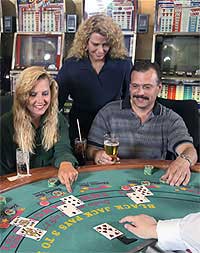
11. There are five different decisions that can be made by a player after receiving their initial two cards: HIT, STAND, SPLIT, DOUBLE or SURRENDER.
HIT: “Hitting” is when you draw another card in an attempt to get closer to 21 without busting. In a “face up shoe game”, you ask for another card by tapping or scratching the table behind your cards with a finger.
12. STAND: “Standing” is when the player declines additional cards, instead playing the cards he/she has. The signal for “stand” is a horizontal wave of the hand over the cards.
13. SPLIT: (or “Splitting Pairs”) If the first two cards are equal in value they may be played in two separate hands. The signal to split a pair is to place another bet, equal to your initial bet, alongside your initial bet. Do not touch your cards, the dealer will split your cards. For example: you may split two Eights. Sixteen is a very poor hand (actually the poorest!). But the expectation is always that a high card will be dealt ...so two eights have the potential to become two 18s. But if you draw a Three on the first Eight (a total of Eleven) you can double down on that hand. Or if a third Eight is drawn, you can re-split them making yet another hand. Casinos usually allow a player to split up to 3 times, making 4 separate hands, with 4 separate bets. Hint: Never split 10 value cards (tens, or matching face cards.) A 20 is a very good hand.
Two special rules generally apply when you spit Aces. First: you get one card (and only one) and Second; it is not a Blackjack if you get a 10-value card ...just a normal 21. Players should always split Aces. Consult your “Basic Strategy” card for advice on when to split matching pairs.
14. SURRENDER: Offers the player the opportunity to fold the hand (decline playing the two cards dealt) at a cost of half the bet. Not every casino allows a player to “surrender.” Once you begin playing the two cards dealt, you no longer may surrender. There are two types of surrenders: “Early” and “Late.” They differ only in the way a dealer handles a possible Blackjack. “Early surrender” is where a player is allowed to fold before the dealer checks for Blackjack. (A good time to “Early Surrender” would be if the player has a 16 and the dealer has an Ace showing.) This gives a player an inexpensive way out even if the dealer turns out to have a Blackjack. Not many casinos offer “Early Surrender.” “Late Surrender” is more common. This is where the dealer has an Ace showing and checks for Blackjack. If the dealer does not have Blackjack, then players may fold (“surrender”.) . When to “surrender” is easily answered by using the Blackjack Basic Strategy chart. Hint: Players should always “surrender” if they have a 16 against the dealer’s Nine, Ten or Ace. Players with 15 should surrender against a Ten.
15. DOUBLE (or “Doubling down" as it is called) allows a player to double the original bet by placing another bet equal to and alongside your first bet. The dealer will deal you one more card (and only one) additional card. Doubling must be done before a third card has been drawn. Since nearly half of all cards are high value, a good doubling opportunity is when you have a hand totaling Eleven against a dealer’s poor up-card ...such as a Six. Again, when to “double” is easily answered by using the Blackjack Basic Strategy chart. Hint: 38.5% of all cards are Ten thru Ace ...46.2% are Nine or higher.
16. INSURANCE is a hedge side bet to protect your original bet when the dealer turns a Ace up card. When this happens, the dealer will offer “Insurance” to the players. Insurance bets are made by betting up to half your original bet amount. If the dealer has a 10-value card underneath his Ace (a Blackjack), your winning Insurance bet will be paid at odds of 2:1. If the dealer does not have Blackjack, you'll lose the insurance bet. In any event, you still have to play the original bet. It is universally considered good basic strategy to never make the insurance bet since it has a high house advantage. (There is about a one-in-three chance that the dealer will have a Blackjack, but Insurance pays two-to-one ...instead of three-to-one. Never take Insurance.)
Basic Strategy
...or what do I do now?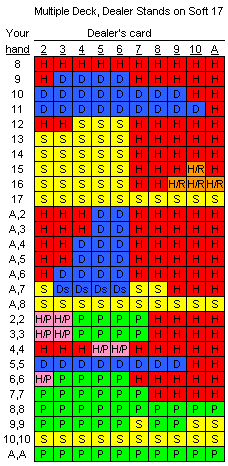
Besides being available in casino gift shops, “Basic Strategy” cards/charts can be found on the Internet. (Here is one we found.)
Some charts can be slightly different because some casinos allow doubling on any two cards, while others restrict doubling to the Nine, Ten or Ace ...or just the Ten and Ace.
There can also be restrictions on doubling after a split and whether or not surrender is offered. Most cards/charts assume doubling on any two cards or after a split ...but no surrender.
| H = | Hit (Red) |
| S = | Stand (Yellow) |
| D = | Double (Blue) |
| P = | Split (Green) |
| H/P = | Split, if you can double after spit, otherwise Hit (Pink) |
| H/R = | Surrender, if allowed, otherwise Hit (Orange) |
Here is a recap of what most (but not all) charts say...or what a player should do if the total of your first two cards equals:
“Hard” Hand totals:- 5 thru 8 --- Always hit.
- 9 --- Double down if dealer shows Three thru Six, otherwise hit.
- 10 --- Double down if dealer shows Deuce thru Nine, otherwise hit.
- 11 --- Always double down.
- 12 --- Stand if dealers shows Four thru Six, otherwise hit.
- 13 thru 16 --- Stand if dealer shows Deuce thru Six, otherwise hit.
- 17 thru 20 --- Always stand.
- Soft 13 thru 14 --- Double down if dealer shows Five thru Six, otherwise hit.
- Soft 15 thru 16 --- Double down if deaer shows Four thru Six, otherwise hit.
- Soft 17 --- Double down if dealer shows Three thru Six, otherwise hit.
- Soft 18 --- Double down if dealer shows Three thru Six. Stand if dealer shows Deuce, Seven or Eight. --- Hit if dealer shows Nine, Ten or Ace.
- Soft 19 --- Double down if dealer shows Six, otherwise stand.
- Soft 20 --- Always stand.
- Ace and Ace --- Always split Aces.
- Deuces, Threes --- Split if dealer shows Four thru Seven, otherwise hit.
- Fours --- Double down if dealer shows Five or Six, otherwise hit. (If double not allowed split if dealer shows Five or Six.)
- Fives --- Double down if dealer shows Deuce thru Nine, otherwise hit. Never split.
- Sixes --- Split if dealer shows Three thru Six, otherwise hit.
- Sevens --- Split if dealer shows Deuce thru Seven, otherwise hit.
- Eights --- Always split Eights.
- Nines --- Split if dealer shows Deuce thru Six, or Eight or Nine, otherwise stand.
- Tens --- Always stand on Tens.
- Aces --- Always split Aces.
- Always split Aces and Eights.
- Split Deuces and Threes against a dealer up-card of 4 to 7.
- Never split Fours, Fives, or Tens.
- Split Sixes against a dealer up-card of Three to Six.
- Split Sevens against a dealer up-card of Two to Seven.
- Always split Nines, except against a dealer up-card of Seven, Ten, or Ace.
- Stand on 12 against Four to Six.
- Stand on 13 thru 16 against Deuce to Six.
- Stand on 17 thru 20 In all cases.
Play Blackjack in a casino with good Blackjack rules. This means that you can double after split, double on any two cards, and split pairs up to four times, and that the dealer doesn't hit on soft 17.
If nothing else, remember these seven simple rules:- Blackjack must pay 3:2, avoid odd rules.
- Always split Aces and Eights.
- Double down with 10 or 11 against a dealers up card of Deuce thru Nine.
- Stand with 12-16 against a dealers up card of Deuce thru Six.
- Hit with 12-16 against a dealers up card of Seven and higher..
- Stand on Seventeen and higher.
- Never take insurance.
Want to learn more about blackjack? A good website is BlackjackInfo .com. They have Basic Strategy charts that can be customized, some free blackjack games you can play ...even a trainer that warns you if you make plays that are not perfect Basic Strategy. Another Basic Strategy trainer is located here. Try it out!
Card countingCard counting is discouraged by casinos, because (while not illegal) keeping track of high and low cards played gives the player an edge. Playing basic strategy correctly gives the player a pretty much even chance to win. All you need to know is that cards with values of Deuce thru Six generally are poor cards and there are nearly 40% of them. Ten-count cards and Aces are the most favorable, also about 40% of them. Keeping track of them in a constantly shuffled six to eight deck “shoe” game is just about impossible ...so forget about “counting.” The main thing to remember is that if a dealer has a Deuce thru Six, the chances of a player winning (and the dealer losing) are good. Conversely, if a dealer has a high card showing, the chances are the player will lose.
A word about “comps”
Present your players card to the pit boss for rating every time you sit down at a Blackjack table. You might increase your bet when the pit boss is watching. It will improve your chances of getting “comps” ...free stuff. A “comp” (as in “complimentary”) is a perk given by the casino. The purpose of “comping” is two-fold ...to build customer loyalty and to activate your name in the casino’s database for marketing purposes. Frankly, we are not a big fan of playing just to get comps.Realistically, unless you bet a minimum of $25 a hand, most casinos are generally not interested in giving you “free stuff.” The Blackjack “comps” formula is generally based on an average of one Blackjack hand a minute (60 hands an hour) times $25 (or $1,500 wagered) times 2% (their profit ...$30). For “comp” purposes your share is 40% (or $12 per hour.) And that’s if you play $25 on every hand.
If you do, you might ask to meet the casino host after 3 or 4 hours of play. Inquire about free rooms, shows, upgrades, meals.... It never hurts to try. The worst thing that could happen is that the host will say “No.” And you might get offered something else instead.
One thing you should never lose sight of. That is, anything you get free from a casino is not really free. The “freebie” is almost always based on your theoretical loss ...and the casino’s profit. You get it because the casino wants you to keep coming back so they can make more money off of you.
A better idea might be to just bet the table minimum as long as possible. You have a good chance of winning if you are lucky and play perfect, basic strategy at all times. The house advantage against a Blackjack strategy player is about one-half of one percent. That's as good as it gets in a casino.
NEXT PAGE: 10.5 OTHER CASINO TABLE GAMES... ⇨